


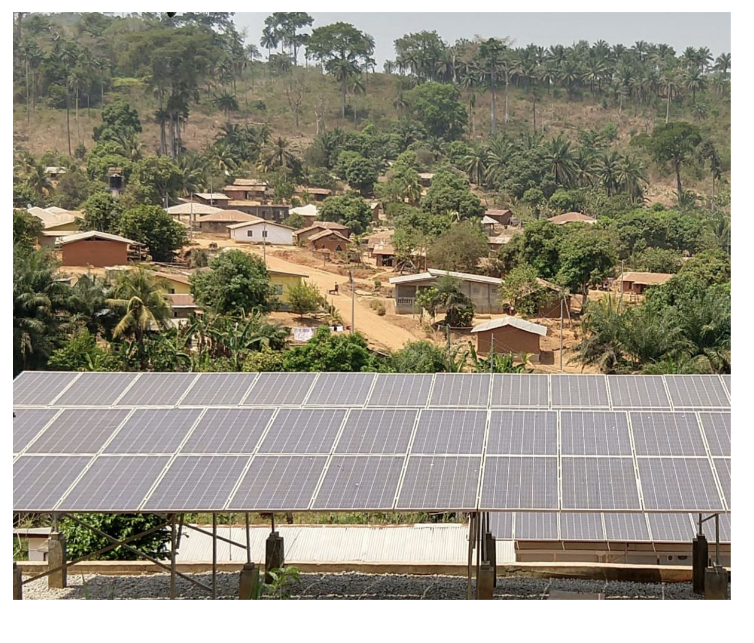
Image Credit: InfraCo Africa
Introduction
Just a little over half (59.5%) of Nigeria’s population was connected to the national grid by 2021. The Nigeria Integrated Planning Tool suggests that, despite the potential for mini-grid systems as the least cost electrification method for the 31% of unelectrified population, grid extension remains the least cost electrification method for 30% of the unelectrified population. This was revealed by Uche Honnoh, then the Component Coordinator for Solar Mini Grids for Nigeria Electrification Project, at a Panel Discussion at the Solar Quarter Solar Week Nigeria Conference & Awards in November 2022, Abuja, Nigeria. The implication is that, ultimately, the national grid will remain the dominant source of electricity in Nigeria (for about two thirds of the population). Improving the performance of the national grid will therefore continue to be a priority for Nigeria.
Nonetheless, there is a potential role that mini-grids can play in doing this. Mini-grids, which can provide 100 kWh to 1MW of electricity to a community, have been praised for their potential in electrifying a large percentage of Nigeria’s unelectrified population and at the same time contributing to rural development by being a gateway to introduction of productive use equipment. They may also help to catalyse other renewable energy sectors (such as e-mobility and e-cooking) which contribute to more productive energy utilisation.
There is, however, another potential benefit to mini-grids that has not received adequate attention among practitioners or analysts. This benefit is the impact of the mini-grid sector on the national grid sector itself, whose failure in Nigeria is partly why the country is the second largest potential mini-grid market in sub-Saharan Africa and the largest in West Africa.
The EPSRA’s Failed Emulation of India’s Power Sector Reforms
In the early 2000s, Nigeria embarked on the most ambitious electricity sector reform effort of any African country. The Electric Power Sector Reform Act 2005 unbundled and partly privatised the Nigerian Electricity Supply Industry (NESI).
As researchers at the SOAS Anti-Corruption Evidence (ACE) Center note, power sector privatisation in Nigeria was modelled on the Indian example whose underlying distribution of actors, power and capabilities significantly differed from the Nigerian case.
In India, it was the mismanagement-induced financial crisis (and the default on payments for coal feedstock to the central government) experienced by the State Electricity Boards (SEBs) – the agencies charged with coordinating generation, transmission and distribution in each Indian state – which necessitated privatisation. The National Thermal Power Corporation (NTPC) (with an installed capacity of 57,356 MW) remained profitable enough to set the yardstick for private sector performance. Additionally, the much larger and stronger Indian manufacturing sector set up its own huge Captive Power Plant (CPP) programme which was allowed to feed into grids after privatisation. CPPs with a generation capacity above 1 MW currently have an installed capacity of over 40,000 MW. The CPP cluster could also effectively put pressure on public-sector generators and distributors to keep electricity at reasonable prices. The State Electricity Board in Gujarat State also had its high prices contested by SME clusters.
It was “Such horizontal checks and balances across different types of organisations were only possible because there was a broader and more diversified base of productive capabilities in both the private and public sectors in India.” State governments were entirely reliant on PHCN for their energy needs, and there were no substantially large independent power projects that could serve as a check against the national grid system.
Therefore, while installed capacity had risen from 6,199.2 MW at the time of privatisation to about 13,000 MW today (although well below the goal of 40,000 MW by 2020 set in 2001 and well below its African peers such as South Africa), power distribution averages around 4,000 MW owing to gross inefficiencies along the entire electricity value chain. As Zainab Usman, director of the Africa Program at the Carnegie Endowment for International Peace emphasises, the early Fourth Republic administration in general did not manage to mobilise enough interests to transform a wide range of industries. Whereas the cement, telecommunications, banking and financial services industries saw great developments, the oil refining, textile manufacturing and other industries did not. The power sector was therefore not alone in generating disappointments.
Nigeria’s weak industry made it so that the attempts by the Manufacturers Association of Nigeria (MAN) to establish Independent Power Projects (IPP) for its members at industrial clusters since 2009 have been relatively very small projects (about 30 MW each) and often been unfruitful. While many state governments built IPPs with the intention to generate, transmit and distribute electricity to end users, none has been successful in participating in electricity distribution within its territory, due to the provisions of the EPSRA. Self-generation through petrol- and diesel-powered generator sets is too individualised, small scale, fragmented and non-competitive with the national grid to have any impact on the NESI.
It was partly in order to create windows of opportunity for pockets of horizontal checks that one proposal was to create a “parallel electricity market (PEM)”. The PEM was proposed to break the monopsony of the Nigeria Bulk Electricity Trading (NBET) at the wholesale end of the Nigerian Electricity Supply Industry (NESI) since generation companies (GenCos) are unable to supply electricity directly to willing credit-worthy buyers (especially industrial customers and clusters) on a cost-reflective tariff basis through the national grid because the existing regulatory regime does not support it.
The Emerging Horizontal Checks
A Africa Minigrid Developers Association (AMDA) 2022 report demonstrates that mini-grids in Africa outperform traditional utilities on service up-time, power quality, number of reliable connections and downstream job creation. Onyinye Anene-Nzelu, Head of Mini Grids at Engie Energy Access Nigeria, highlighted at the Solar Quarter Solar Week Nigeria Conference & Awards in November 2022, Abuja, her experience of how the superior performance and services of mini-grids developers influence customers to hold utilities to higher standards and expect better performance from them. Yet billions of dollars are being poured into traditional utilities, a statement by AMDA implying that mini grids deserve the funding instead. One implication is that if grant funding – which makes up the largest source of finance for mini-grid deployment in Nigeria – slows down, the demonstration of superior mini-grid performance could create future national budgetary competition between national utilities and the mini-grid sector.
The Nigerian Electricity Regulatory Commission (NERC) Consultation Paper on Proposed Review of Regulations for Mini-Grids 2016 included a suggested amendment to the Regulations for Mini-Grids 2016 that also seeks to bypass inefficient behaviour among distribution companies (DisCos). The suggested amendment is for a DisCo’s confirmation to be automatically assumed to be given to a mini-grid developer if after four weeks the distribution company (DisCo) fails to confirm that the mini-grid activities will not interfere with the expansion plans into the designated unserved area.
In addition, interconnected mini-grids based on tripartite agreements between a DisCo, a mini-grid developer and a community have also been tested and are slowly being deployed. In general, the subtle change in the narrative of mini-grids as a tool for from “off-grid” electrification to “least cost” electrification signifies a reframing that increasingly allows for some level of competitive interaction between the mini-grid sector and the utilities sector.
While some may expect some push back from utilities, Uche Honnah, argued at the same award event that DisCos will be attracted by the appeal of working with a single customer rather than many small customers. They would also enjoy decreased losses (from electricity theft) and increased revenues (from more efficient tariff collection). He noted that some DisCos are already setting up internal units dedicated to interconnected mini-grid activities. The argument is that the less enthusiastic DisCos will wake up and get on board when they see successful cases become more common and their peers making gains. Indeed, in an interview with the General Manager of an electricity board in a south-western State, it was revealed that the Managing Director of the DisCo to which his state was franchised has expressed his readiness to work with mini-grid developers. Thankfully, the number of DisCos (11) in Nigeria is small enough to make diffusion quick if it does indeed occur.
Another argument, made by Anene-Nzelu at the Award event, emphasised the huge market which precludes intense competition at the moment and provides abundant opportunities for partnerships. Moreover, there are significant volumes of grant financing being channelled into the mini-grid sector that utilities can take advantage of through the interconnected mini-grid segment.
State governments have also begun to pursue their own electricity supply programmes. In 2021, the Lagos State’s Ministry of Energy & Mineral Resources interpreted being underserved by the national grid as having a functional status of being off-grid. The argument was then made that it was consequently within the powers of Lagos State to pursue an electricity generation, transmission and distribution system within its boundaries. Ultimately, in mid-2022, the Nigerian Senate passed the Electricity Bill, 2022 to replace the Electricity and Power Sector Reform Act 2005, which gives states the explicit right to engage in electricity generation, transmission and distribution. This was signed into Law by Nigeria’s president in 2023.
Additionally, Jigawa, Kaduna, Kano and Lagos States were supported by the Africa Clean Energy Technical Assistance Facility (ACE TAF) to develop their own Off-Grid Solar (OGS) policies; while Delta and Ondo States are developing theirs with the support of Clean Technology Hub (CTH) and sponsored by Heinrich Böll Stiftung (HBS).
Finally, discussions around hydrogen fuel cells are beginning to take off in Nigeria. The German Government is supporting several initiatives to drive this sector. The national grid system is now facing, for the first time, a triple horizontal siege which could be just what Nigerians need to end the gridlock that has plagued the Nigerian Electricity Supply Industry (NESI) for decades.
However, this mould likely take several more years to blossom. Installed mini-grid capacity is below 1,000 MW, and the sector is still heavily grant-funded—although there are efforts to scale private sector financing through aggregation. Green and/or blue hydrogen is yet to be tested and scaled in Nigeria, although pilot projects are currently being rolled out. And state governments are only at incipient stages in building competitive state electricity industries, not to mention the major challenges they face in doing so.
The hope is that, with a NERC amendment allowing for single rounds of regulatory due process for multiple mini-grid sites, reduction of bureaucratic delays and complementary funding to accelerate such larger-scale mini-grid deployment, mini-grid developers will achieve the scale needed to put greater pressure on the utilities sector. Likewise, the presence of natural gas and the involvement of capital-abundant oil and gas companies could make hydrogen deployment in Nigeria, with the attendant involvement of large commercial and industrial (C&I) off takers (such as Dangote Industries), grow rapidly.
Conclusion
As billions of naira increasingly pour into Nigeria’s energy transition, it is important to ensure that the substantial imbalances of power and lack of horizontal checks in the Nigeria Electricity Supply Industry are addressed. The vision for revamping the Nigerian power utilities sector cannot continue to exist independently of the growth of other actors and sectors with the potential to serve as horizontal checks. Development partners and donors supporting power sector reform and investment may well benefit from thinking more strategically about the role that supporting actors play in overcoming vested interests. By viewing this potential impact more strategically than incidentally, Nigeria could accelerate the speed of achievement of its universal energy access goals.
Abel B.S. Gaiya* is the Manager, Energy Access, at Clean Technology Hub.