


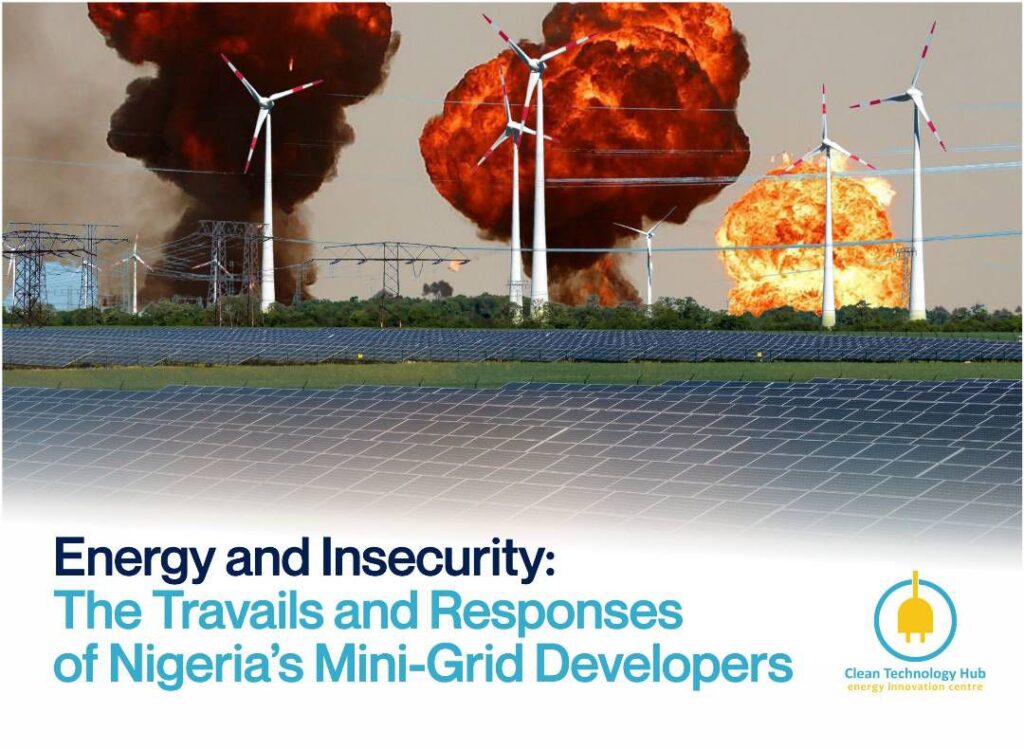
Banditry, kidnapping, herder-farmer clashes and insurgency are words which regularly fly across the Nigerian media space each day. Yet as insecurity besets rural communities across the country, the challenges of rural development and rural electrification still persist.
The remoteness and dispersion of rural settlements makes it too costly to extend the main grid to many rural communities in Nigeria. This same factor also makes it more difficult for the government to provide safety against insecurity to these rural communities. Therefore, where security is lacking, many communities continue to experience both high levels of insecurity and high levels of energy poverty.
Mini-grids have been championed as a solution for rural electrification, and an alternative to small generators which are bad for the climate. A mini-grid is “a stand-alone power system or an integrated local generation and distribution system with installed capacity below 1MW, capable of serving numerous end users independent of the national grid”. These can range in size from micro (typically serving 20‐100 customers) to full mini‐grids (serving over 500 customers).
Research conducted by Clean Technology Hub reveals that insecurity has had an impact on the mini-grid solution in recent years. Interviews with developers show that they are observing disruptions to their mini-grid activities in several states and localities in various ways.
The Problems, and Measures Taken
Mini-grid developers typically conduct site feasibility evaluation, in which security is an important criterion for site selection. Therefore, locations in high-insecurity areas are often rejected for mini-grid projects. In addition to this, the worsened security situation has pushed some developers from a focus from rural to peri-urban sites, and consequently from isolated to interconnected mini-grid systems.
Sometimes in-person site evaluation and mini-grid installation cannot be performed due to security risks to the field personnel. Field personnel are at risk of getting kidnapped or suffering other forms of insecurity. One developer in the South South reports having personally escaped a failed kidnap attempt. Another developer has noted that as early as 2019, nine northern states, including Plateau, had been rated as having high security risk and thus the developer’s personnel could not be sent there.
In addition to more careful security assessments for site selection, developers have sought to overcome these challenges by providing security escorts for field personnel. A developer in the South South warns that this may sometimes be counterproductive in some sites, where it may look aggressive or may falsely suggest that the personnel are wealthy. When first visiting the site, field personnel generally visit the police station or army barracks to get information about the safest locations and times to move, as well as to obtain contacts which may eventually come in handy. Some developers hire locals of the communities and train them on mini-grid installation and monitoring. This leverages the locales’ better assessments and navigability of security risks. Another major adaptation, partly as an operational response to the COVID-19 pandemic, is the digitization of some operations to monitor and follow-up on installations.
Transportation of equipment to such areas also becomes a challenge in high-insecurity areas, given the risk of kidnappers and bandits violently intercepting vehicles on expressways. This raises security costs for developers who then have to hire armed security outfits.
By making sites inaccessible, insecurity has also limited developers’ capacity to make lucrative investments in certain states and communities. Some ongoing projects impacted by increases in insecurity, such as those in Niger State, have seen delays or suspensions. A major project which would have serviced thousands of customers, and in which hundreds of thousands of dollars were invested, has been suspended for months. One developer laments that billions of naira worth of contracts in the north have been lost due to the security situation. Delays also come from the inability of the Rural Electrification Agency (REA) to conduct in-person verification of completed projects in high-insecurity locations, thereby resulting in delays of payments to the developers.
In terms of funding, some developers have seen some hesitancy from foreign donors. Some funders have even shifted from debt- to equity-financing to reduce the risk they bear with mini-grid projects. The expectation, as one developer reveals, is that the companies which have their legs on the ground should be able to mitigate the security risks, thereby making the switch to debt-financing unproblematic. Funders nonetheless continue to press developers about security risks and their mitigatory measures taken.
However, developers report that increased security costs have not generally led to increased tariffs to end users. This is not unexpected, since the high-insecurity sites are often excluded from site selection in the first place.
A major developer has temporarily re-focused on providing smaller systems (such as Solar Home Systems) to high-insecurity communities, which may additionally be helpful since they could flee with such mobile systems if the need arises. This is temporary, pending improvements in the security situation, and so that these communities are not completely left out of energy access. Another has outlined plans to reduce country-specific macroeconomic and security risks by extending operations to other countries in West Africa. This option is only available to large developers, and dependent on the ability to access foreign financing for such expansion.
The impact of insecurity on developers differs by the geographical profile of their project portfolio and their degree of specialization in the mini-grid sector. Those with predominant operations in the South South and South West tend to face less challenge from insecurity. And those for whom mini-grids represent a minority of their business activity also face less risk.
Role of Mini-Grids for Rural Communities
For rural communities, mini-grid systems could help them maintain vigilance against security threats (night-time security and street lights), react better if attacks occur (mobile and internet communication), and rebuild faster in the aftermath of attacks (energy at IDP camps and for post-attack revival of commercial activity).
Even the presence of mini-grid developers in communities may provide them with an additional bridge to urban security contacts. One developer indicated that the presence of personnel and security escorts may improve locals’ perception of the safety of the project and the community. Additionally, the developer may sometimes be a bridge between the community and security contacts. This was the case when a developer was called in the middle of the night by a community leader at a project site, appealing for them to contact security forces after they had received an indication of an impending attack from bandits.
Conclusion
The mini-grids sector is critical for the journey away from rural energy poverty in Nigeria. Yet insecurity threatens to impede the achievement of rural electrification policy targets and developers’ expansion plans in the next five years and beyond. This demands greater attention from the state, and the need for all stakeholders to be involved. Developers remain hopeful and optimistic that the security situation would get better and the mini-grid sector would continue to grow and adapt. In the meantime, mini-grids can still play a role in helping rural communities adapt to insecurity.